Conversaciones En Español
Updated: Feb 9, 2023

The best part about traveling in Mexico are the many conversations we have in Spanish. Vince and I are now fluent enough to easily converse in our second language. We usually start right away with the Uber or taxi drivers who transport us from the airport to our Mexican lodging. Some drivers barely say a word, probably because they assume we don’t speak their language. Others speak some English, want to practice (just like we want to practice our Spanish), and start a conversation right away. But if we start speaking Spanish, most drivers will engage in conversation. Often we start with questions about the city we are visiting at the time. What are the main attractions? Where are the best restaurants? How far is it to the nearest pueblo mágico? We have discovered that Uber and taxi drivers are generally well-informed and eager to share their knowledge with visitors.
If we have more time, we can have deeper, more detailed conversations in Spanish. This happened when we were in Oaxaca recently. We stayed at a small inn and shared several meals with the family that owned it. At those dinners, Vince and I were able to ask questions about the owners’ history as well as discuss Mexican politics, education, and religion. We were also able to provide details about our own family and country. Those types of discussions always enrich our experiences in Mexico and motivate us to make return trips.
It was during our time in Oaxaca that we had an entire day of conversation in Spanish. Vince had arranged a tour of some nearby attractions. We thought that a group of tourists would be joining us on that trip but when the driver and guide arrived to pick us up, we realized that it was just us. Even better! We climbed in the car and immediately began speaking in Spanish. Although they also spoke English, these two young men were more than happy to converse in their native language. We spent hours in the car talking about the history of the region and sharing information about the sites we were planning to visit. It was clear that the guide was very knowledgeable, and we talked with him about his training and experience. It was also obvious that the driver was very experienced as we watched him easily navigate the treacherous road that led us to the first place we visited that day, Hierve El Agua.
Vince described our trip to Hierve El Agua on his Facebook page. On that post he wrote:
Hierve el Agua has petrified "waterfalls" formed by water from mineral springs. To get there, we couldn't take the "good road" (whatever that means) because the village through which it passes had blocked it. Instead we took a dirt road through a different village, which had taken advantage of the situation to charge a toll. Basically, they put some boulders in the road to force you to stop and then a bunch of burly guys stand in front of your car until you pay. A little later you have to get out of the car so they can spray you head to foot with who knows what. After that we were glad of our federally-certified driver's credentials and skills because the road climbed the mountain with hair-raising drop-offs and no guardrails (of course). He passed other vehicles going uphill with literally no room to spare. I made sure to keep the conversation going so Eileen wouldn't notice.
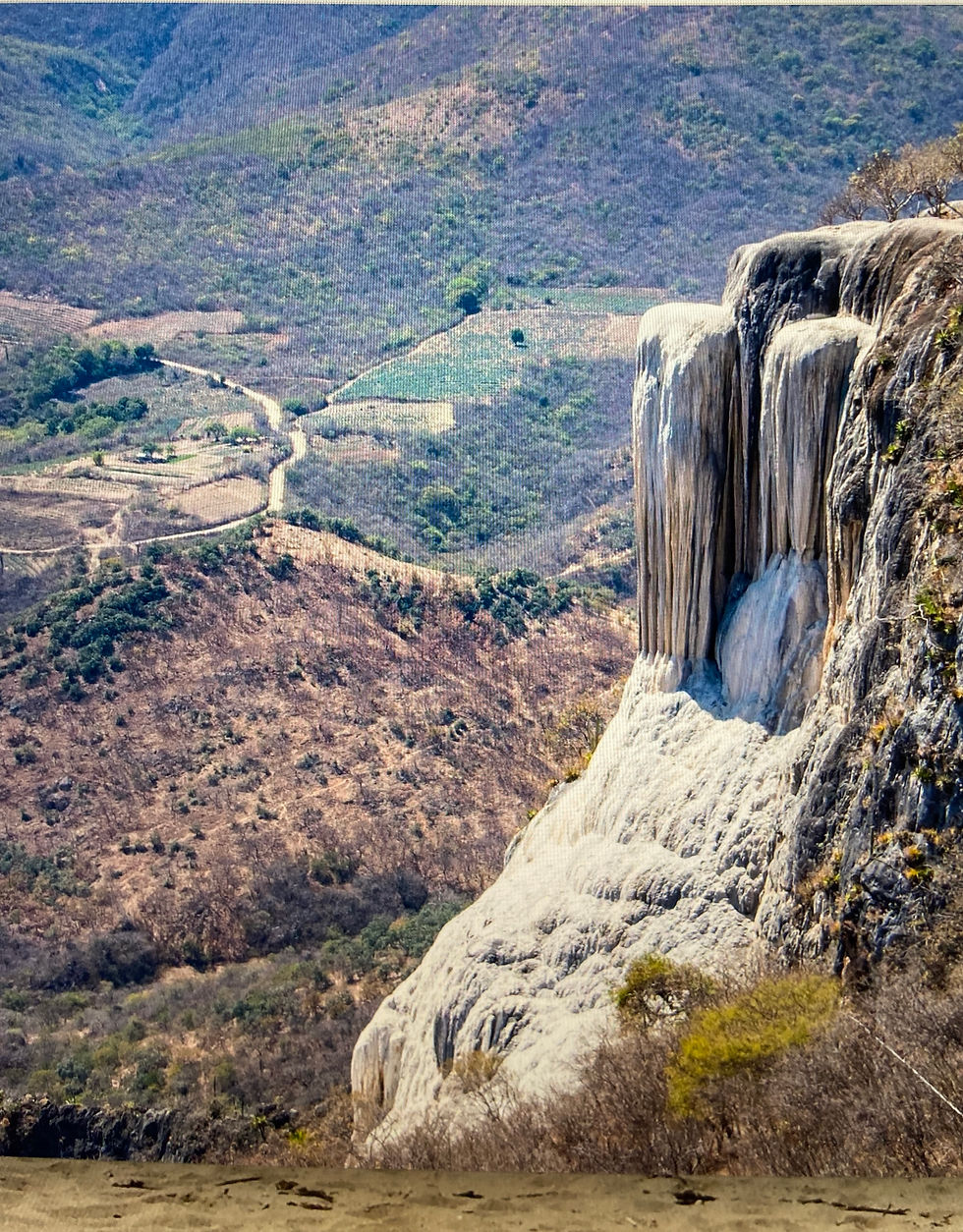

At Hierve El Agua, we spent some time hiking around the top of the mountain and taking photos of the “waterfalls.” Several tourists were bathing in the mineral pools above the falls but the sun was too intense for us to consider changing into bathing suits. Instead, we jumped back into the tour car and continued our conversation in Spanish with the guide and driver.
Our next stop was the Zapotec archaeological site of Mitla. When we arrived, our guide informed us that another guide who knew more about that specific site would be showing us around. Although the new guide was bilingual, we expressed our preference for a tour in Spanish and he readily agreed. This guide was also very knowledgeable about the history and development of the area. He pointed out the well-preserved geometric mosaics that are unique to Mitla. Theses designs do not exist on other ancient Mexican buildings. At the time we thought that it was our first visit to Mitla and the designs were new to us. But when we went through the photos from our previous trip to Oaxaca in 1988, we realized we had been to Mitla before. I’m glad we were able to see it again and acquire new knowledge of it in Spanish.


On the way back to Oaxaca, our guide encouraged us to stop at a nearby village known for rug weaving. We had already purchased a small rug in Oaxaca and had very little room to spare in our luggage, but we agreed.
We turned off the main road and followed a dirt road to a collection of low, modest buildings. Our guide directed us to one of the buildings where a young Zapotec woman gave us a tour of several rooms set up for various stages of rug production. She showed us where the wool was carded then spun into yarn. In the next room, bundles of yarn were dyed various colors using local, natural resources such as flowers, bugs, herbs, and fruit. Finally the brightly colored yarn was woven into intricately designed rugs. Interestingly, the Zapotec men do most of the rug weaving.
At the end of our tour, the woman led us to a large showroom where hundreds of rugs were in piles around the room. The rugs were beautiful. Although this woman and her husband tried to persuade us to buy one of the bigger rugs, we settled on a small one that we thought would complement the one we had already purchased in town. We realized later that the first rug had also been made in the same village, maybe even by the same family.


We left the village and headed back to the posada where we were staying in Oaxaca. On the way, we continued our conversation with the driver and guide. They told us about their families and their work with the tour company. Before the pandemic, they had served large groups of tourists, but the virus had put a stop to their business for many months and things were just beginning to improve as tourists slowly returned. At one point, Vince asked them what they did for work during the pandemic. “We sold lemons,” they replied, “The company lent us a car, we filled it with lemons and drove to various neighborhoods trying to sell them.” The money they made wasn’t nearly enough to support themselves or their families but they felt lucky that at least they were able to earn something. They were hopeful that tourism would continue to increase so they could return to their previous level of earnings. We hoped so too as they were personable, good at their jobs, and able to provide a welcome service to travelers like us.
The sun was setting when we finally made it back to the inn. It had been a wonderful day filled with new sights, lots of walking, and practically nonstop conversation in Spanish. My head hurt from thinking in my second language, but I was grateful for the opportunity to communicate and connect with people I met that day and during our entire trip to Mexico. Our conversations in Spanish definitely made the trip more memorable and gave us insight into the country and its people.


Comments